Case Study #1: FASTER ISN’T ALWAYS BETTER
An Operational Analysis of the Speedy Rewards Redesign
Bunny Studio × Spotify Ads — Senior Production Management
PROJECT OVERVIEW
At Bunny Studio, I served as Senior Production Manager overseeing high-priority voice-over production for Spotify Ads, one of the platform’s key enterprise accounts. A recurring workstream within this account was “Speedy” projects — voice-over jobs requiring significantly faster turnaround than standard production timelines. When the company changed the financial incentive paid to voice artists for accepting Speedy work, I led the operational analysis to determine whether the new structure was actually improving business outcomes or introducing hidden costs elsewhere in the pipeline.
BUSINESS CHALLENGE
Incentive changes are easy to implement and hard to evaluate. A higher reward can look successful on the surface — more artists opting in, faster initial pickup — while quietly straining other parts of the operation: approval quality, client satisfaction, or the sustainability of the voice artists pool. Bunny Studio needed a clear, evidence-based answer on whether the new Speedy Rewards structure was working as intended before deciding whether to keep it, adjust it, or roll it back.
OBJECTIVES
The analysis was designed to answer a specific set of operational questions: whether the reward change improved fulfillment times; whether it affected approval and rejection rates; whether it changed the number of voice artists available per project; whether project volume shifted; whether overall operational efficiency improved; whether faster turnaround came at the cost of quality; and what the likely downstream impact on revenue and customer experience would be.
MY APPROACH
I treated this as a structured before-and-after operational review rather than a one-off report. That meant gathering and organizing the relevant weekly data from our internal systems, identifying which KPIs actually reflected the business questions at hand, and building a comparison window on either side of the reward change. From there, I looked for correlations between the reward change and shifts in volume, approval behavior, and turnaround speed, and translated what I found into a set of recommendations that stakeholders could act on.
DATA & KPIS ANALYZED
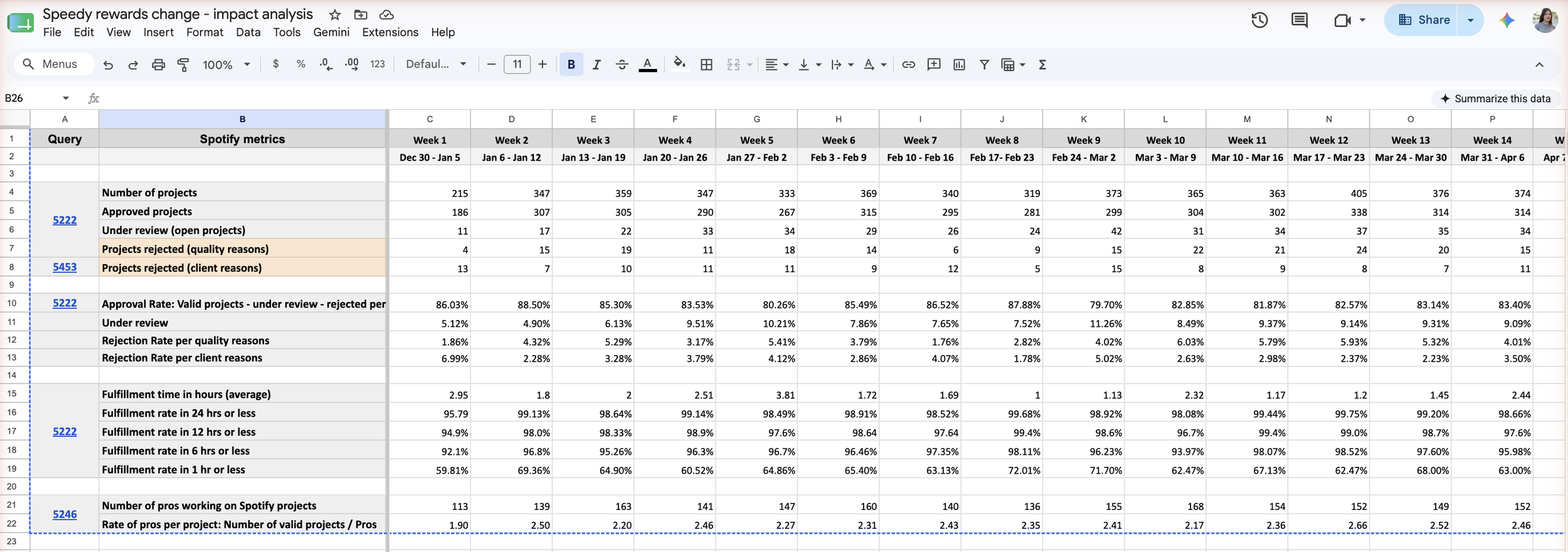
Working from weekly operational data spanning several months before and after the change, I tracked total project volume and approved-project counts; approval rate and rejection rate, split by quality-related and client-related rejection reasons; the share of projects sitting in “under review” status; average fulfillment time and the percentage of projects completed within 24, 12, 6, and 1-hour windows; and the number of active pros working on Speedy projects alongside the ratio of projects to available voice artists.
ANALYSIS PROCESS
I built a week-by-week comparison spanning the periods immediately before and after the incentive change, rather than relying on a single snapshot, to account for normal week-to-week variance. For each KPI, I compared pre-change and post-change averages and trend lines, cross-referenced volume changes against approval and rejection behavior to see whether growth was being absorbed cleanly or creating backlog, and checked whether gains in speed were tracking with or diverging from quality indicators. Findings were compiled into a shared summary that internal stakeholders could review together.
KEY FINDINGS
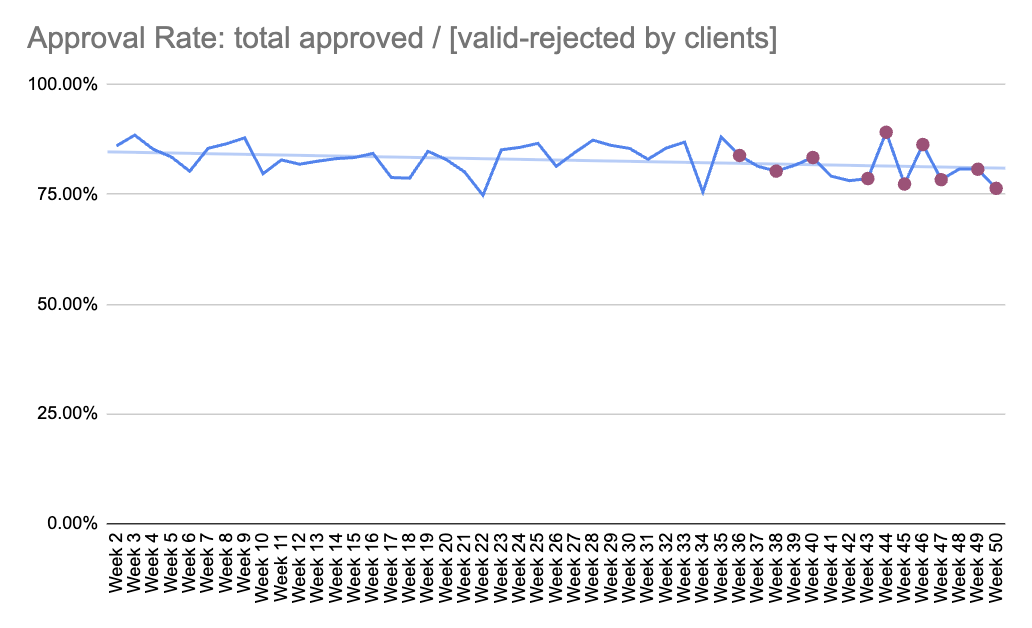
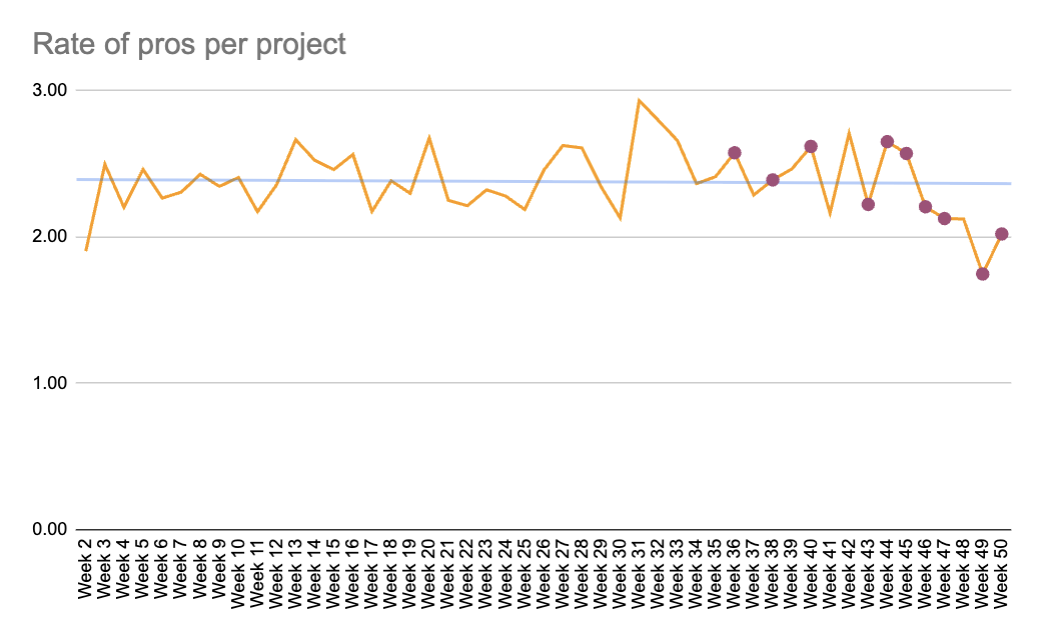
Project volume trended upward in the weeks following the change, alongside a modest increase in the number of pros actively working on Speedy projects — consistent with a stronger reward drawing more voice artists into the pool. However, the ratio of available pros per project softened slightly, suggesting the pro pool didn’t scale in lockstep with demand. On the quality side, the overall approval rate moved slightly downward, with both quality-related and client-related rejection rates ticking up compared to the pre-change period. Fulfillment within the fastest tier (1 hour or less) — arguably the most direct measure of whether Speedy was delivering on its core promise — also declined slightly, even as fulfillment within the broader 24/12/6-hour windows held steady or improved marginally. Taken together, the data pointed to a more nuanced picture than “the new reward made things faster”: it grew participation and volume, but showed early signs of quality and speed-tier trade-offs that warranted closer monitoring.
RECOMMENDATIONS
Based on these findings, I recommended that the team treat the reward change as a partial success requiring refinement rather than a finished solution: monitor the quality-rejection trend over a longer window to confirm whether it was a temporary adjustment period or a sustained pattern; consider tiering or adjusting the incentive specifically for the fastest turnaround bracket, where performance had softened; and set up an ongoing KPI review cadence so that future incentive changes could be evaluated on the same before/after framework going forward.
BUSINESS IMPACT
This analysis gave production and account leadership an evidence-based view of a change that had previously been evaluated only anecdotally. It reframed the conversation from “is the new reward popular with pros” to “is it improving the metrics that actually matter to the client and the business,” and gave stakeholders a concrete basis for deciding whether to adjust the incentive structure rather than leaving it in place by default.
TOOLS USED
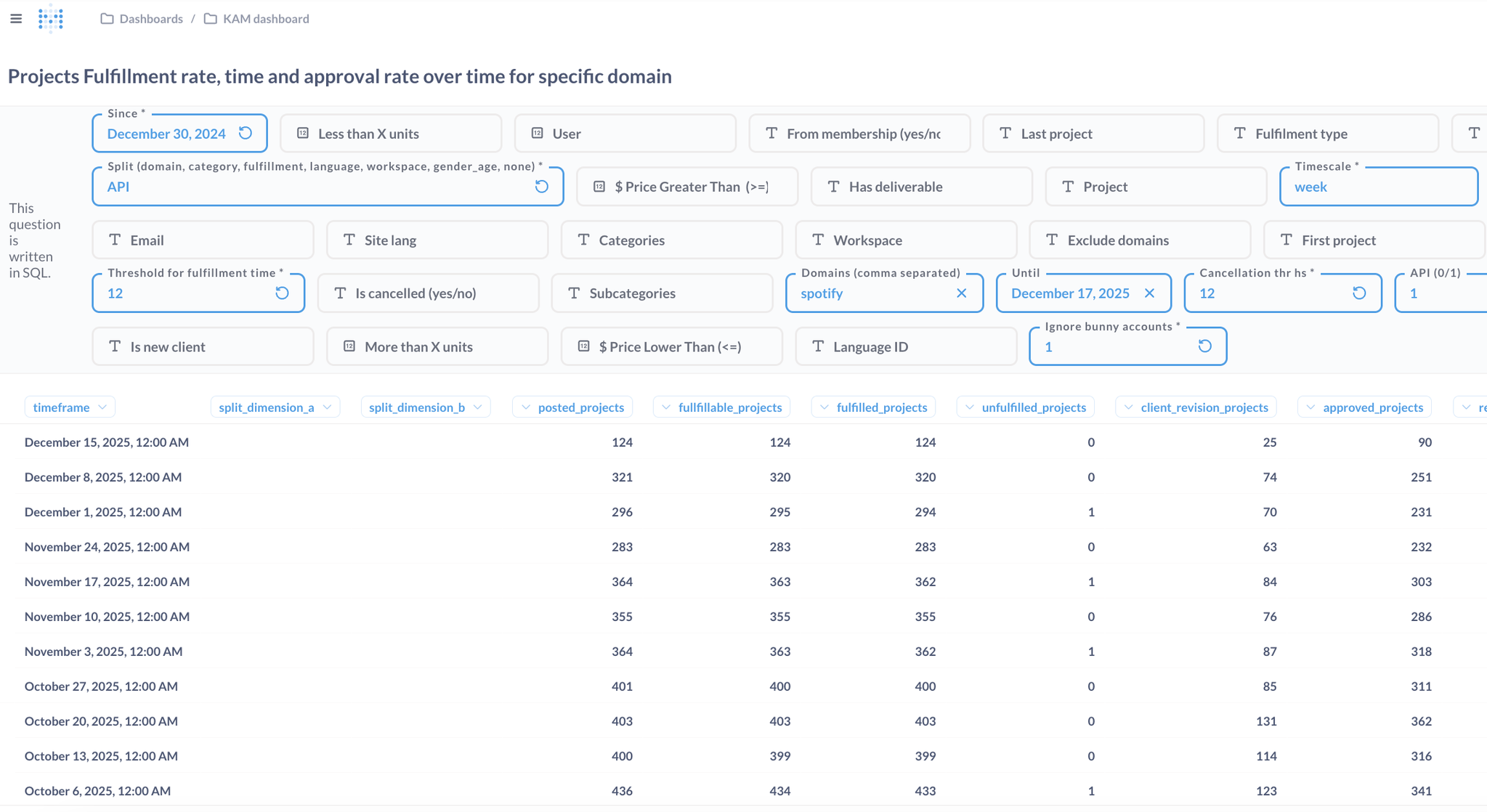
Google Sheets and Metabase for data aggregation, KPI tracking, and reporting; internal Bunny Studio production systems as the source of operational data; Claude and ChatGPT to help analyze patterns, structure findings, and build supporting graphics; and structured stakeholder reporting for translating analysis into a decision-ready summary.
Case Study #2: More Instructions, Less Clarity
A Workflow Optimization for TagWorldWide’s Localization Pipeline
Bunny Studio × TagWorldWide – Senior Production Management
PROJECT OVERVIEW
At Bunny Studio, I served as Senior Production Manager supporting our account with TagWorldWide (TagWW), a localization client managing multi-language voice-over projects across a large pool of contracted Pros. Over time, our production team identified a set of recurring friction points across the project lifecycle, from brief submission through QC and final delivery. I led an internal review to diagnose these bottlenecks and translate them into a concrete, two-sided action plan for our team and the client.
BUSINESS CHALLENGE
TagWW projects moved through several teams, including briefing, syncing, production, QC, and customer support, and small inconsistencies at any one stage tended to compound by the time a project reached delivery. Overly long and inconsistent briefs slowed project kickoff, syncing instructions built around full scripts rather than each Pro’s assigned lines created confusion, and feedback delivered as unstructured spreadsheets was often difficult to act on. QC and Pros did not always share the same reference material, and communication was split across scattered threads rather than organized by project. None of these issues were severe on their own, but together they were driving up revision cycles, delaying fulfillment, and straining Pro availability for harder-to-staff languages.
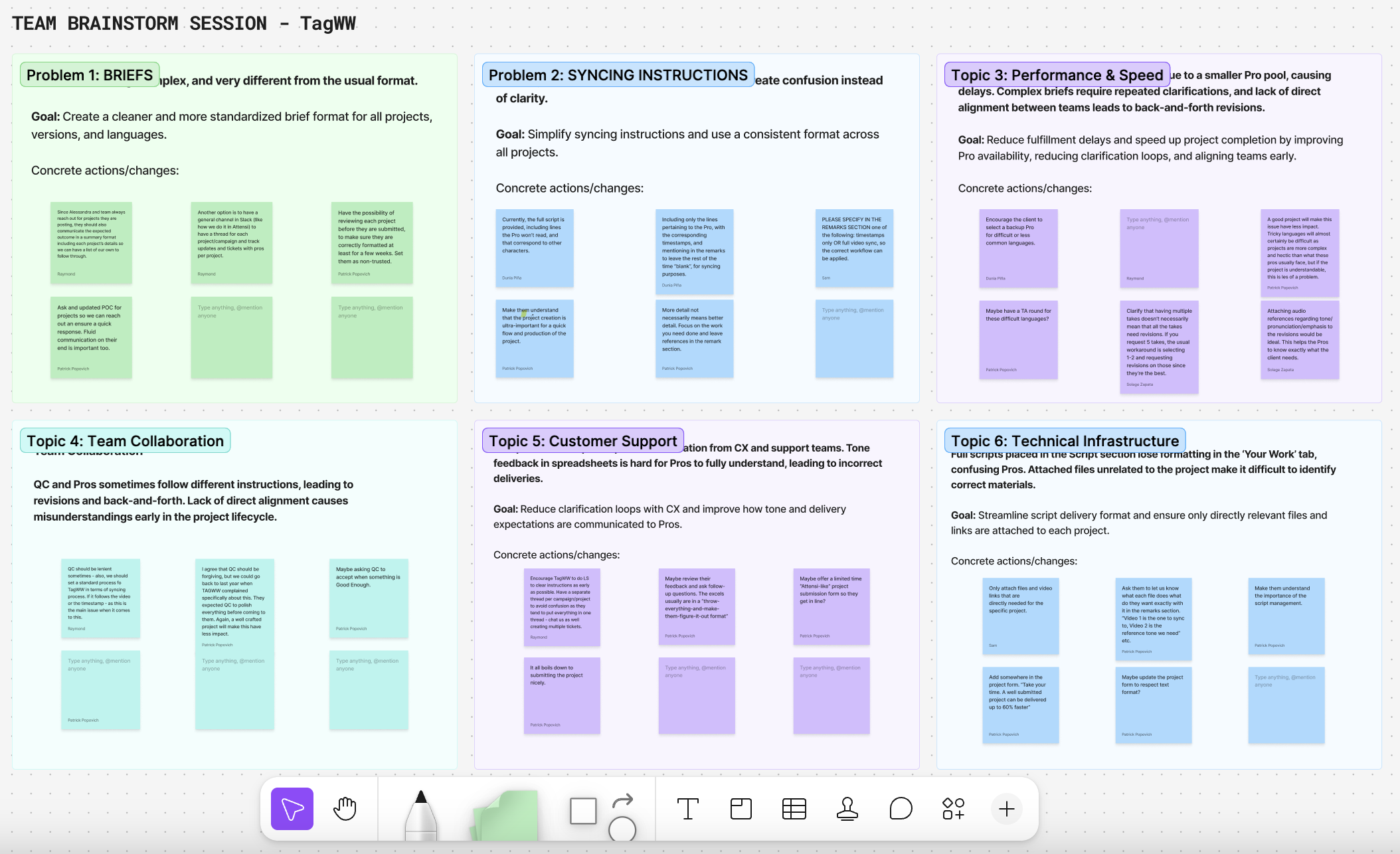
Collaborative Figma Brainstorming
OBJECTIVES
The review set out to answer a specific set of operational questions: where in the project lifecycle revisions and delays were actually originating; which bottlenecks were driven by client-side submission practices versus internal process gaps; how briefing, syncing, and QC standards could be simplified without losing necessary detail; and what concrete, ownable actions on both sides of the partnership would meaningfully reduce friction and speed up delivery.
MY APPROACH
I treated this as a structured diagnostic and action-planning exercise rather than a one-off list of complaints. That meant gathering input directly from the team members handling TagWW projects day to day, facilitating a collaborative brainstorm to surface and categorize issues by topic, and translating those findings into a clear, prioritized set of proposed changes that TagWW and our internal team could both review and adopt.
BOTTLENECKS IDENTIFIED
Working with the production team, I ran a structured brainstorming session in Figma, mapping six recurring problem areas across the project lifecycle: brief standardization, syncing instructions, performance and speed, team collaboration and QC alignment, customer support and feedback communication, and technical infrastructure and project management. Each topic was broken down into its underlying issue, the desired outcome, and the concrete actions needed to close the gap.
ANALYSIS PROCESS
For each of the six problem areas, I worked with the team to separate root cause from symptom, distinguishing, for example, between a brief that was hard to follow because of formatting and one that was hard to follow because it contained too much irrelevant information. I used Claude and ChatGPT to help organize the raw brainstorm notes into a structured document, cross-check that proposed actions actually addressed the stated issue, and consolidate overlapping suggestions across topics into one coherent action plan.
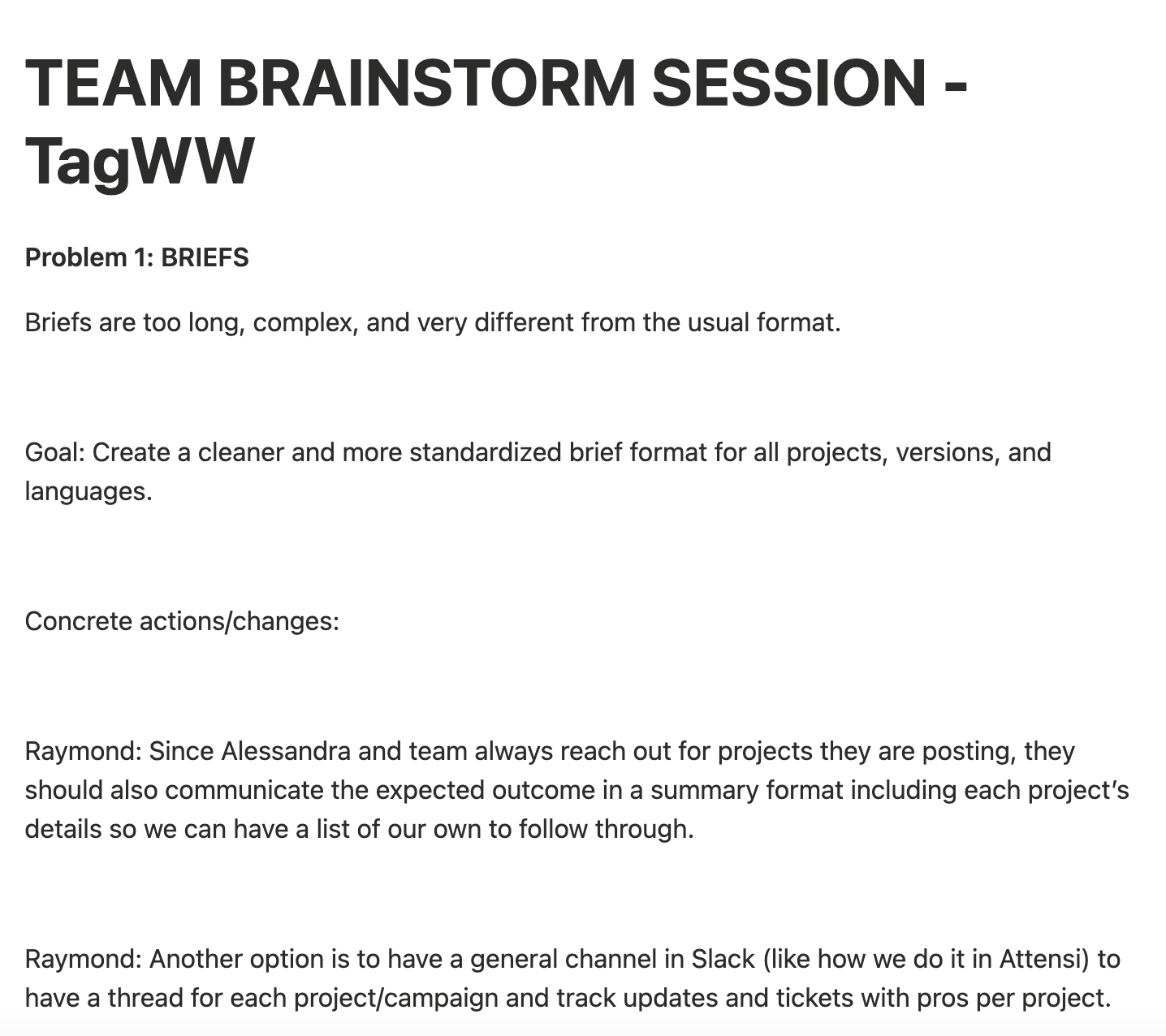
Notion Documentation and AI-powered analysis conclusions
KEY FINDINGS
The review found that most friction was not caused by any single failure, but by inconsistency: briefs that varied in format from project to project, syncing instructions that mixed full scripts with assigned-line-only requests, feedback that arrived as unstructured spreadsheets, and QC that sometimes worked from different assumptions than the assigned Pro. A recurring theme across nearly every topic was that more detail was often mistaken for more clarity: full scripts, bundled communication threads, and catch-all feedback documents were adding review time without improving accuracy. Limited Pro availability for certain languages, combined with a lack of backup talent, was also identified as a direct driver of fulfillment delays.
RECOMMENDATIONS
Based on these findings, I proposed a two-sided action plan. On TagWW’s side: adopt a standardized brief format with a clear project summary, provide scripts limited to each Pro’s assigned lines with timestamps, specify sync type in the remarks field, attach only directly relevant reference files with a description of each file’s purpose, designate backup Pros for difficult languages, limit revisions to the top one or two selected takes, and keep communication organized in dedicated threads per project or campaign. On our internal side: introduce a brief review step during a trial period, maintain an updated point of contact list, document a standard syncing process shared across QC and Pros, calibrate QC judgment to project context, review client feedback internally before relaying it to Pros, and set up dedicated Slack channels per project to centralize communication.
BUSINESS IMPACT
This action plan gave both TagWW and our internal team a shared, concrete framework for reducing revision cycles and improving turnaround time, rather than relying on ad hoc fixes after each project ran into friction. By clearly separating what the client needed to change from what our team would own internally, the proposal made the plan actionable on both sides and set a foundation for faster, more consistent delivery going forward.
TOOLS USED
Figma for collaborative workflow mapping and brainstorming; Notion for documenting findings and structuring the action plan; Claude and ChatGPT to help synthesize brainstorm notes and organize recommendations; and stakeholder presentation materials to communicate the final proposal to TagWW.
Final Workflow Optimization proposal presented to TagWW